
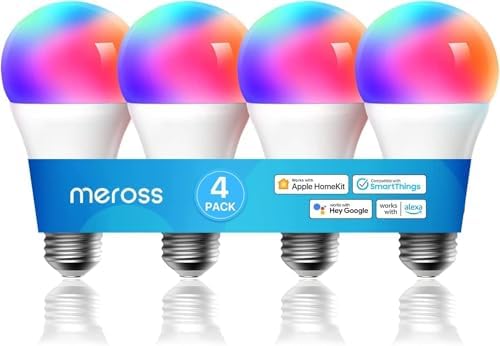
The meross bulb takes the lead in this group because it pairs directly with Apple HomeKit over Wi-Fi with no hub in the chain, states the highest warm-white brightness at 900 lumens, and covers the full 2700K to 6500K white range plus RGB color. That combination of direct pairing, stated brightness, and color range is the best stated package here, and it is why the meross bulb is the main pick in this guide.
The other four bulbs all reach HomeKit, but they do it by different routes, and the route matters more than the brand name. Two connect through Matter, one runs on Thread or Zigbee, and one states plainly that a Matter hub is required. None of that makes them poor choices — it only changes what else must already sit in the home before the bulb works. Read the hub notes before choosing, because a bulb that needs a hub you do not own is a bulb that cannot join HomeKit at all.
As an Amazon Associate, we earn from qualifying purchases.


Pick by Your Need
- Best overall: meross Smart LED Light Bulb. Direct HomeKit pairing with no hub required, the highest stated warm-white brightness at 900 lumens, and a 2700K to 6500K white range plus RGB color.
- Best two-bulb set: LIFX Color Smart Light Bulbs. The only stated 2-pack here, with Matter support, 800 lumens, and the widest stated white range at 1500K to 9000K.
- Best for color variety: DoHome Smart Light Bulbs. Sixteen million stated colors with Wi-Fi and Bluetooth control, plus group control and timer scheduling through its app.
- Best for a Matter home: Amazon Basics Smart A19 LED Bulb. A Matter-certified bulb that works with Alexa, Google Home, and Apple HomeKit, with a stated requirement for a Matter hub.
- Best for Thread and Zigbee: Aqara Smart LED Light Bulb T2. Dual Thread and Zigbee support with the highest stated brightness at 1100 lumens and a 2000K to 9000K white range.
Quick Answer
Choose the meross bulb when a direct HomeKit connection with no hub is the priority, since its listing states HomeKit pairing over a 2.4GHz Wi-Fi network with no hub required. Choose the LIFX 2-pack when two rooms need bulbs at once and Matter support is acceptable, or the Aqara T2 when a Thread or Zigbee setup already exists and the stated 1100 lumens matters most. The Basics bulb fits a home that already has a Matter hub, because its listing states plainly that a Matter hub is required.
Comparison Table
| Bulb | Stated brightness | White range | Connection | Hub required | Stated weight | Buy |
|---|---|---|---|---|---|---|
| meross Smart LED | 900 lm | 2700K–6500K | Wi-Fi 2.4GHz | No | 0.53 lb | View on Amazon |
| LIFX Color (2-pack) | 800 lm | 1500K–9000K | Wi-Fi 2.4GHz, Matter | No | 0.28 lb | View on Amazon |
| DoHome Smart | not stated | 2700K–6500K | Wi-Fi + Bluetooth | not stated | not stated | View on Amazon |
| Amazon Basics Smart A19 | 800 lm | not stated | Wi-Fi 2.4GHz, Matter | Yes, Matter hub | 0.09 lb | View on Amazon |
| Aqara LED Bulb T2 | 1100 lm | 2000K–9000K | Thread / Zigbee | Yes, for Zigbee mode | 0.31 lb | View on Amazon |
Decision Guide
Start with the connection route, because it decides whether the bulb works at all. The meross bulb and the LIFX bulbs connect over Wi-Fi with no hub stated as required, so they suit a home with no hub hardware. The Basics bulb states that a Matter hub is required, and the Aqara T2 needs a Thread border router or a Zigbee hub depending on the mode chosen. The DoHome bulb states Wi-Fi and Bluetooth control with no hub mentioned in its listing.
Next, weigh brightness against color range. The Aqara T2 states the highest brightness at 1100 lumens, followed by the meross bulb at 900 lumens, while the LIFX and Basics bulbs both state 800 lumens. The DoHome bulb states no lumen figure, so its brightness cannot be ranked against the others. For white range, the LIFX bulb states the widest span at 1500K to 9000K, the Aqara T2 follows at 2000K to 9000K, and the meross and DoHome bulbs both state 2700K to 6500K.
Pack size changes the value of the comparison. The LIFX listing is a 2-pack, so its stated figures cover two bulbs. The meross, Basics, and Aqara listings are single bulbs. The DoHome listing states a 2-count size field, but its listing text describes a single bulb, so treat its pack count as unclear and confirm the listing before ordering.
Dimming ranges also differ in the stated figures. The LIFX bulb states dimming from 1% to 100%, the DoHome bulb states the same 1% to 100% range, and the Basics bulb states dimming from 5% to 100% through the app and voice. The Basics listing also states that the bulb does not support connection with a physical dimmer, which matters for rooms with a wall dimmer switch.
Finally, check the stated extras that only some bulbs offer. The Aqara T2 states circadian lighting sync, but only in Zigbee mode, and only with a compatible Aqara hub. It also states power-off memory, so the bulb can be set to stay off after a power outage instead of turning on unexpectedly. The meross bulb states a separate antenna for stronger Wi-Fi signal. The LIFX bulb states more than 200 themes in its app. The DoHome bulb states group control for a whole home of lights.
One caution applies across the whole group: stated weights and dimensions in this category often describe packaging rather than the bulb alone, so use them only as rough guides. The Basics bulb states 0.09 lb, which reads as unusually light next to the meross bulb at 0.53 lb, and the DoHome bulb states no weight at all. Compare brightness, white range, and hub needs first, and treat weight as a secondary figure.
1. meross Smart LED Light Bulb — Best overall
The meross Smart LED Light Bulb pairs directly with Apple HomeKit, Apple Watch, Siri, Alexa, Google Assistant, and SmartThings, and its listing states that no hub is required. It runs on a 2.4GHz Wi-Fi network and can be controlled through the Apple Home app or the Meross app from anywhere with internet access. The listing states 900 lumens of warm white light, a 2700K to 6500K white range, and multiple RGB colors, with dimming and brightening by voice command.
| Spec | From the listing |
|---|---|
| Brightness | 900 lumens warm white |
| White range | 2700K–6500K |
| Color | Multicolor, RGB |
| Connection | Wi-Fi 2.4GHz, no hub required |
| Dimensions | 2.36 × 2.36 × 4.33 in |
| Weight | 0.53 lb |
The trade-off is clear: the meross bulb offers the simplest stated setup and the highest stated warm-white brightness, but its size field is confusing and it is the heaviest bulb in the group. Skip it if the pack-count wording in the listing leaves the quantity in doubt.
2. LIFX Color Smart Light Bulbs 2-Pack — Best two-bulb set

The LIFX Color Smart Light Bulbs arrive as a stated 2-pack of A19 E26 bulbs with Matter support, 800 lumens each, and 82+ CRI. The listing states SuperColor and Polychrome technology with billions of RGB colors, a tunable white range from 1500K candlelight to 9000K daylight, and dimming from 1% to 100%. The bulbs connect through Wi-Fi at 2.4GHz with no hub required and work with Apple HomeKit, Siri, Alexa, Google Home, and Samsung SmartThings.
| Spec | From the listing |
|---|---|
| Brightness | 800 lumens |
| White range | 1500K–9000K |
| Color | RGB + tunable white, billions of colors |
| Connection | Wi-Fi 2.4GHz, Matter, no hub required |
| Dimensions | 2.36 × 2.36 × 4.13 in |
| Weight | 0.28 lb |
The trade-off is breadth against brightness: the LIFX bulbs state the widest white range and the only 2-pack, but their stated 800 lumens sits below the meross and Aqara bulbs. A buyer who needs only one bulb should note that this listing is a 2-pack.
3. DoHome Smart Light Bulbs — Best for color variety

The DoHome Smart Light Bulbs work with Apple HomeKit and can be controlled through the HomeKit app or the CozyLife app, with scheduling for automatic on and off times. The listing states 16 million DIY colors, a warm to cool white range of 2700K to 6500K, and brightness adjustable from 1% to 100%. Voice control covers Apple HomeKit, Apple Watch, Siri, Alexa, Google Assistant, and SmartThings, and group control lets several lights be managed together.
| Spec | From the listing |
|---|---|
| Brightness | The listing does not state it |
| White range | 2700K–6500K |
| Color | 16 million DIY colors, GRBCW |
| Connection | Wi-Fi + Bluetooth |
| Dimensions | 2.76 × 1.57 × 2.36 in |
| Weight | The listing does not state it |
The trade-off is color and control against missing numbers: the DoHome bulb states a wide color range with group control and scheduling options, but its listing states no brightness figure and no weight, so brightness cannot be compared against the others.
4. Amazon Basics Smart A19 LED Bulb — Best for a Matter home

The Basics Smart A19 LED Bulb is Matter-certified and compatible with Alexa, Google Home, and Apple HomeKit, and its listing states plainly that a Matter-compatible smart hub is required. It supports 2.4GHz Wi-Fi only and offers remote control from anywhere using the app. The bulb is dimmable from 5% to 100% up to 800 lumens through the app and voice, and the listing states that it does not support connection with a physical dimmer.
| Spec | From the listing |
|---|---|
| Brightness | 800 lumens |
| White range | The listing does not state it |
| Color | Multicolor |
| Connection | Wi-Fi 2.4GHz, Matter |
| Dimensions | 2.36 × 2.36 × 4.21 in |
| Weight | 0.09 lb |
The trade-off is compatibility against the hub requirement: the Basics bulb states broad Matter compatibility, but it cannot work without a Matter hub. That hub requirement is the deciding factor for any home without one.
5. Aqara Smart LED Light Bulb T2 — Best for Thread and Zigbee

The Aqara Smart LED Light Bulb T2 supports both Zigbee and Thread protocols, and its listing states 1100 lumens with a tunable white range of 2000K to 9000K and 16 million colors. In Zigbee mode, the bulb offers exclusive Aqara features and Matter compatibility through an Aqara hub, plus circadian lighting that syncs with nature — a feature the listing states is not supported in Thread mode. Power-off memory lets the bulb be set to stay off after a power outage.
| Spec | From the listing |
|---|---|
| Brightness | 1100 lumens |
| White range | 2000K–9000K |
| Color | RGB, 16 million colors |
| Connection | Thread / Zigbee |
| Dimensions | 2.36 × 2.36 × 4.25 in |
| Weight | 0.31 lb |
The trade-off is power against setup complexity: the Aqara T2 states the highest brightness and the most flexible protocols, but its best features depend on the mode and hub chosen. Skip it if a hub-free Wi-Fi bulb is preferred.
Buying Checklist
- Confirm the connection route first: direct HomeKit over Wi-Fi, Matter, Thread, or Zigbee, and check whether a hub is stated as required.
- Match the stated brightness to the room: the Aqara T2 states 1100 lumens, the meross bulb states 900 lumens, and the LIFX and Basics bulbs state 800 lumens.
- Check the stated white range: LIFX states 1500K to 9000K, Aqara states 2000K to 9000K, and meross and DoHome state 2700K to 6500K.
- Verify the pack count in the listing, since the LIFX listing is a 2-pack and the DoHome size field is unclear.
- Confirm dimmer compatibility: the Basics bulb states it does not support a physical dimmer.
- Check the base and size: meross, LIFX and Aqara state an E26 base, with heights from 4.13 in to 4.33 in; DoHome and the Basics bulb state no base.
FAQ
Do all five bulbs connect directly to HomeKit?
No. The meross bulb states direct HomeKit pairing over Wi-Fi with no hub required, and the DoHome bulb states HomeKit control through the HomeKit app. The LIFX and Basics bulbs reach HomeKit through Matter, and the Basics listing states that a Matter hub is required. The Aqara T2 reaches HomeKit through Thread or Zigbee, depending on the mode, and needs a Thread border router or a hub.
Which bulb states the highest brightness?
The Aqara T2 states the highest brightness at 1100 lumens. The meross bulb follows at 900 lumens, and the LIFX and Basics bulbs both state 800 lumens. The DoHome bulb states no lumen figure, so its brightness cannot be ranked against the others.
Does the Basics bulb work without a hub?
No. Its listing states “Matter Hub Required” and describes the bulb as Matter-certified with a Matter-compatible smart hub required. A home without a Matter hub cannot use this bulb with HomeKit, so confirm a hub is already in place before choosing it.
Final Verdict
The meross bulb is the best overall pick here because it states direct HomeKit pairing with no hub required, the highest stated warm-white brightness at 900 lumens, and a full 2700K to 6500K white range plus RGB color. For a two-room setup, the LIFX 2-pack is the practical alternative with the widest stated white range. For the brightest stated light and the most flexible protocols, the Aqara T2 leads at 1100 lumens, provided a Thread border router or Zigbee hub is available. The Basics bulb fits only a home that already has a Matter hub, and the DoHome bulb suits a buyer who values color variety and scheduling over a stated lumen figure.
Prime covers fast, free delivery on eligible items. See whether a Prime free trial is available for your account.
Check Prime on Amazon →Types of Smart Light Bulbs
Smart light bulbs are grouped mainly by connectivity protocol and by color capability.
Wi-Fi bulbs connect straight to a home network with no extra hardware. Hub-based bulbs (such as those using Zigbee or Z-Wave) need a separate bridge or hub device but often use less power to stay connected and can be more reliable at scale. White-only bulbs adjust brightness and sometimes color temperature (warm to cool white); color-changing (RGB) bulbs add a full color range. Common socket shapes (A19, BR30, and others) determine which fixtures a given bulb physically fits.
A hub-based smart bulb ecosystem generally handles a large number of bulbs more reliably than connecting many Wi-Fi bulbs directly to a home router, since each Wi-Fi bulb takes up its own network connection rather than routing through one hub.
Frequently Asked Questions
Do smart bulbs need a hub to work?
Wi-Fi smart bulbs connect directly to a home network with no hub, while hub-based bulbs (Zigbee or Z-Wave) need a separate bridge device but can be more reliable with many bulbs installed.
What's the difference between white-only and RGB smart bulbs?
White-only bulbs adjust brightness and sometimes color temperature; RGB (color-changing) bulbs add a full range of colors beyond white light.
Why would a large smart-bulb setup use a hub instead of Wi-Fi bulbs?
A hub-based ecosystem generally handles many bulbs more reliably than connecting each one directly to a router, since Wi-Fi bulbs each take up their own network connection.


Write Your Review
No reviews yet. Be the first to share your experience!