
Pick the LUTEC 72W for the highest stated output, the LEPOWER 40W if sensing range matters most, and a solar 2-pack, Tuffenough or MIHANI, if the mounting spot has no wiring. The ALUSSO 30W sits between those poles as the only model with a choice of color temperature.
The set splits into three hardwired models and two solar models, with stated output from 2,500 to 7,500 lumens. Stated sensing distance runs from 26 feet to 72 feet, and one model, the MIHANI, gives a detection angle but no distance figure; the MIHANI and the ALUSSO both give no numeric waterproof rating.
As an Amazon Associate, we earn from qualifying purchases.




Pick by Your Need
- Best overall: LUTEC 72W 3-Head. Highest stated output at 7,500 lumens, with a 180-degree sensor reaching 69 feet and four modes including dusk to dawn.
- Best without wiring: Tuffenough Solar 210 LED. Solar charging, a wireless remote and a 2-pack format suit spots with no wiring nearby.
- Best color choice: ALUSSO 30W. Three color temperatures, 3000K, 4000K and 6500K, selected at the back, plus three modes.
- Best wide coverage: MIHANI Solar 2-Pack. Three adjustable heads spread light across a stated 270-degree angle, covering two mounting points.
- Best sensing range: LEPOWER 40W. A stated 72-foot reach at a 180-degree detection angle, the longest distance figure here.
Quick Answer
For a wired wall over a driveway, the LUTEC 72W gives the most stated light at 7,500 lumens, while the LEPOWER 40W trades output for the longest stated sensing range at 72 feet. For a fence line or gate with no wiring, pick a Tuffenough or MIHANI solar 2-pack at 2,500 lumens. The ALUSSO 30W is the pick when you want to choose the color temperature yourself.
Comparison Table
| Product | Best for | Key figure | Trade-off | Buy |
|---|---|---|---|---|
| LUTEC 72W 3-Head | Brightest stated output | 7,500 lumens | Heaviest here at 2.44 lb, fixed 5000K | View on Amazon |
| Tuffenough Solar 210 LED | Spots without wiring | 2,500 lumens | Shortest stated sensing distance, 26 ft | View on Amazon |
| ALUSSO 30W 3CCT | Color temperature choice | 3,500 lumens | Detection reaches 40 ft, mid-set | View on Amazon |
| MIHANI Solar 270° | Wide-angle coverage | 270° lighting angle | No sensing distance figure given | View on Amazon |
| LEPOWER 40W | Longest sensing range | 72 ft sensing range | Output below the LUTEC at 4,000 lumens | View on Amazon |
Decision Guide
Start with the power source. If the mounting point has wiring, the LUTEC, ALUSSO and LEPOWER are the candidates: the ALUSSO listing states a hardwire AC 120V connection, and the LEPOWER is listed as hardwired. If there is no wiring at the spot, choose a solar model instead, the Tuffenough with its 1800mAh battery or the MIHANI with its tempered glass panel, and place the panel where it receives daylight.
Next, match sensing distance to the space. A long driveway or deep yard points to the LEPOWER at a stated 72 feet or the LUTEC at 69 feet, both with 180-degree detection. A porch or side path fits the ALUSSO’s stated 40-foot detection in Auto mode or the Tuffenough’s 26 feet. The MIHANI states a 180-degree detection angle but no distance, so its reach cannot be compared on paper.
Then weigh output and spread. The LUTEC states 7,500 lumens, the LEPOWER 4,000 lumens and the ALUSSO 3,500 lumens with a 100-degree beam covering up to 2,000 sq. ft. The solar models state 2,500 lumens each, spread across 270-degree angles, and each 2-pack lights two spots at lower output.
1. LUTEC 72W 3-Head — Best overall

This is the output leader of the set: 72W of LED power producing a stated 7,500 lumens at 5000K daylight, with a 180-degree sensor reaching 69 feet and a timer settable for 1, 3 or 10 minutes. Four modes, including dusk to dawn and a manual override, give the most scheduling control here, and the aluminum body carries an IP65 rating and a stated 50,000-hour lifespan. Weight and flexibility are the costs: at 2.44 pounds it is the heaviest light here, and its color temperature is fixed at 5000K.
Pros
- Highest stated output in the set at 7,500 lumens from 72W
- Four lighting modes, including dusk to dawn and manual override
- Timer settings of 1, 3 or 10 minutes after detection
Cons
- Heaviest stated weight here at 2.44 pounds
- Single fixed color temperature of 5000K
| Spec | From the listing |
|---|---|
| Output | 7,500 lumens, 5000K |
| Power draw | 72W LED |
| Sensing | 180 degrees, up to 69 ft |
| Waterproof rating | IP65 |
| Dimensions | 12.99 x 8.07 x 5.12 inches |
| Weight | 2.44 pounds |
2. Tuffenough Solar 210 LED — Best without wiring

This solar model removes wiring from the decision: 210 LED beads produce a stated 2,500 lumens at 6500K, charged through a solar panel into a built-in 1800mAh battery. Its three heads light a stated 270-degree angle, the PIR sensor reaches 26 feet, and a wireless remote switches between the three lighting modes. At 0.77 pounds it is the lightest stated weight in this set, and the listing is a 2-pack. Reach is the limit: 26 feet is the shortest stated sensing distance here, so it suits a porch or gate better than a long driveway.
Pros
- Solar charging with an 1800mAh battery, no wiring needed
- Wireless remote included for switching the three modes
- Lightest stated weight here at 0.77 pounds, sold as a 2-pack
Cons
- Shortest stated sensing distance in the set at 26 feet
- Output of 2,500 lumens ties for the lowest stated figure
| Spec | From the listing |
|---|---|
| Output | 2,500 lumens, 6500K |
| Power source | Solar panel, 1800mAh battery |
| Sensing distance | 26 ft |
| Waterproof rating | IP65 |
| Dimensions | 1.85 x 3.0 x 3.0 inches |
| Weight | 0.77 pounds |
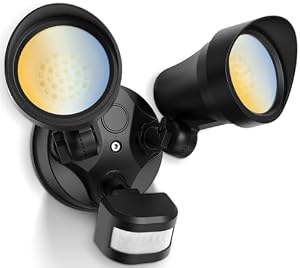
3. ALUSSO 30W 3CCT — Best color choice
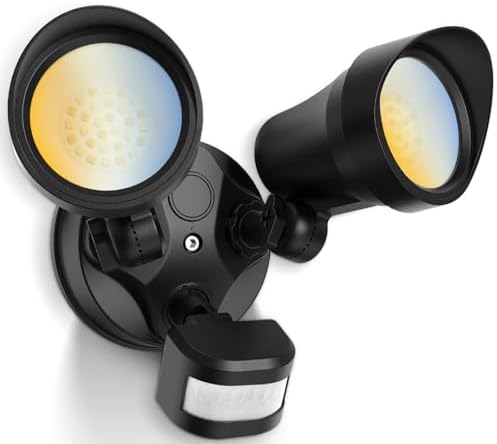
This hardwired model is the only one here that lets you pick the light color: its 30W LED states 3,500 lumens, and a switch on the back selects 3000K warm white, 4000K natural white or 6500K daylight. It connects to AC 120V within a stated 108V to 132V range, detects motion at 40 feet in Auto mode, and its dual heads throw a 100-degree beam covering up to 2,000 sq. ft. Dusk to dawn, Auto and On Time modes cover the scheduling patterns, and the listing states 5 years of coverage. Its listing gives no numeric waterproof rating. The trade-off is that its 40-foot detection sits mid-set, well short of the LEPOWER and LUTEC figures.
Pros
- Three selectable color temperatures, 3000K, 4000K and 6500K
- Stated coverage of up to 2,000 sq. ft. from dual heads
- Listing states 5 years of coverage
Cons
- Detection distance of 40 ft is mid-set
- Listing details give no numeric waterproof rating
| Spec | From the listing |
|---|---|
| Output | 3,500 lumens |
| Color temperatures | 3000K / 4000K / 6500K |
| Power source | Hardwire AC 120V (108V-132V) |
| Detection | 40 ft in Auto mode |
| Waterproof rating | The listing does not state it |
| Weight | 1.3 pounds |
4. MIHANI Solar 270° — Best wide coverage

This solar 2-pack spreads a stated 2,500 lumens at 6500K across a 270-degree lighting angle from three adjustable heads, with a PIR sensor at a 180-degree detection angle. Its tempered glass solar panel carries a stated conversion efficiency of up to 30 percent, and three modes include a motion-activated mode and a permanent-on option. At 2.05 pounds per the listing, it is the heavier of the two solar models. Missing figures are the gap: the listing gives no sensing distance and no waterproof rating number, so its reach and sealing cannot be checked against the other four on paper.
Pros
- 270-degree lighting angle from three adjustable heads
- Tempered glass solar panel, stated conversion up to 30 percent
- Sold as a 2-pack for two mounting points
Cons
- No sensing distance figure in the listing details
- No numeric waterproof rating in the listing details
| Spec | From the listing |
|---|---|
| Output | 2,500 lumens, 6500K |
| Power source | Solar, tempered glass panel |
| Lighting angle | 270 degrees |
| Motion detection | 180 degrees |
| Sensing distance | The listing does not state it |
| Weight | 2.05 pounds |
5. LEPOWER 40W — Best sensing range

This hardwired model leads the set on reach: its PIR sensor states a 72-foot sensing range at a 180-degree detection angle, triggered by people, cars or animals, 3 feet beyond the LUTEC figure. The 40W LED states 4,000 lumens at 5500K daylight through two adjustable heads, the aluminum body carries an IP65 rating and a stated 50,000-hour lifespan, and the listing notes ETL certification. One caution on fit: the listing’s size figures disagree, since the size field gives 10.09 x 4.40 x 7.17 inches while the length, width and height fields give 10.12, 4.51 and 7.55 inches, so check the product page to settle the exact dimensions before ordering. The trade-off is output: 4,000 lumens is a clear step below the LUTEC’s 7,500.
Pros
- Longest stated sensing range here at 72 feet
- IP65 waterproof rating with a stated 50,000-hour lifespan
- ETL certification noted in the listing
Cons
- Size figures conflict between the listing’s own fields
- White is the only color listed for this model
| Spec | From the listing |
|---|---|
| Output | 4,000 lumens, 5500K |
| Power draw | 40W LED |
| Sensing | 180 degrees, up to 72 ft |
| Waterproof rating | IP65 |
| Size field | 10.09 x 4.40 x 7.17 inches |
| Weight | 1.59 pounds |
Buying Checklist
- Measure the mounting area first and compare it with each light’s stated dimensions and weight.
- Decide the power source up front: hardwired models need wiring, solar models need a panel position with daylight.
- Compare stated sensing distance with the depth of your driveway or yard; figures run from 26 to 72 feet.
- Check what is included: single light or 2-pack, and whether a remote is part of the package.
- Check stated modes and timer settings against your routine, such as dusk to dawn or a 1, 3 or 10 minute shut-off.
- Check the return window on the product page before ordering, especially where a listing’s own figures disagree.
FAQ
Which of these flood lights run on solar power?
The Tuffenough and the MIHANI are the two solar models, both sold as 2-packs stating 2,500 lumens. The Tuffenough pairs its panel with a built-in 1800mAh battery, while the MIHANI uses a tempered glass panel with a stated conversion efficiency of up to 30 percent. The ALUSSO listing states a hardwire AC 120V connection with no solar, battery or plug, and the LEPOWER is listed as hardwired.
How far can the sensors detect motion?
Stated figures run from 26 feet (Tuffenough) to 72 feet (LEPOWER), with the LUTEC at 69 feet and the ALUSSO at 40 feet in Auto mode. The LUTEC, LEPOWER and MIHANI all state 180-degree detection angles. The MIHANI gives the angle but no distance figure, so its reach cannot be compared directly.
Which light is the brightest on paper?
The LUTEC states the highest output at 7,500 lumens from its 72W LED. The LEPOWER follows at 4,000, the ALUSSO at 3,500. The two solar models state 2,500 lumens each but spread that output across a wider 270-degree lighting angle.
Final Verdict
The right pick depends on the mounting point. Choose the LUTEC 72W for the highest stated output and four modes, or the LEPOWER 40W when a 72-foot sensing range matters more than raw lumens. Choose the ALUSSO 30W to select the color temperature yourself. Choose the Tuffenough or MIHANI 2-packs where there is no wiring, accepting 2,500 lumens and, on the MIHANI, an unstated sensing distance.
Prime covers fast, free delivery on eligible items. See whether a Prime free trial is available for your account.
Check Prime on Amazon →Types of Flood Lights
Flood lights are grouped mainly by mounting style and by activation method.
Fixed flood lights stay aimed in one set direction once installed. Adjustable (swivel-head) flood lights can be repositioned to change coverage area without reinstalling the fixture. Motion-activated flood lights turn on automatically when they detect movement, common for security use; always-on or switch-controlled flood lights stay under manual control instead.
Flood lights are rated in lumens rather than watts for brightness comparison, since LED flood lights produce far more light per watt than older halogen units, making wattage alone a poor way to compare brightness across technologies.
Frequently Asked Questions
Should I compare flood lights by watts or lumens?
By lumens - LED flood lights produce far more light per watt than older halogen units, so wattage alone doesn't reliably indicate brightness across different technologies.
What's the difference between fixed and adjustable flood lights?
Fixed flood lights stay aimed in one set direction once installed, while adjustable (swivel-head) models can be repositioned afterward without reinstalling the fixture.
Do motion-activated flood lights need to be wired to a switch?
Most still connect to household wiring, but the motion sensor itself controls activation, so a wall switch is typically used just to enable or disable the automatic function rather than to turn the light on directly.
Related Guides
More guides on this site cover motion sensor lighting for bathrooms, garages and switches.
Product and ASIN Reference
| Product | ASIN | Buy |
|---|---|---|
| LUTEC 72W 3-Head Security Light | B0BBV7GFPL | View on Amazon |
| Tuffenough Solar 210 LED | B09F3DJNGF | View on Amazon |
| ALUSSO 30W 3CCT Flood Light | B0DP5YR4VC | View on Amazon |
| MIHANI Solar 270° 2-Pack | B0DFLDYNVD | View on Amazon |
| LEPOWER 40W Security Light | B07XK6ZRHZ | View on Amazon |

Write Your Review
No reviews yet. Be the first to share your experience!