
For a nursery, the JandCase 2-pack gives the brightest stated light here at 750 lumens, while the Wivety adds a remote and sleep timers at 1600K, and the SANSI trades amber for a 670nm red glow at 80 lumens. The Eastiya covers the middle of the temperature range at 1800K and 9W in a 2-pack, and the Neporal keeps the group simple with a 6W LED and flicker-free amber light. All five use an E26 base, and all five aim at evening light with less blue in it.
The numbers split the group cleanly: stated color temperatures run from 1600K to 1900K, stated brightness from 80 to 750 lumens, and stated blue-light blocking from 99.14% to 100%. Two listings carry no lumen figure, and one listing disagrees with itself on size — the Wivety reads A15 in the title and A19 in its size field — so check the product page before judging fit. Each product section pairs its stated figures with its trade-offs.
As an Amazon Associate, we earn from qualifying purchases.


Pick by Your Need
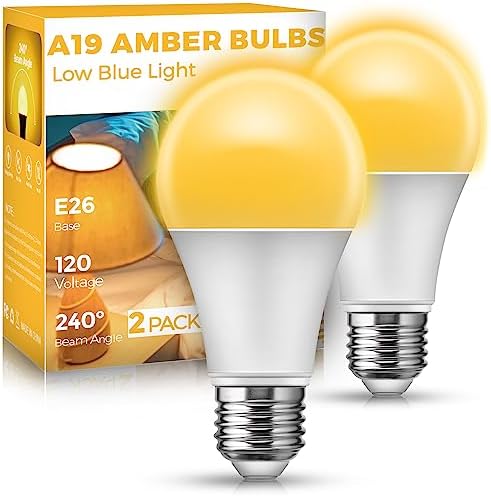
- Best overall: JandCase Sleep Light Bulb. 750 lumens at 1900K in a 2-pack.
- Best simple option: Neporal Amber Sleep Light Bulbs. 6W LED with 40W-equivalent brightness and flicker-free amber light.
- Best remote-control pick: Wivety Amber Sleep Light Bulb. 1600K with a remote, 0.1%–100% dimming and 6 sleep timers.
- Best 1800K two-pack: Eastiya Amber Light Bulbs. 9W and 60W-equivalent brightness in a 2-pack.
- Best red-light pick: SANSI Red Light Bulbs. 670nm deep red at 80 lumens in a 3-pack.
Quick Answer
For most nurseries, the JandCase 2-pack is the pick, with the highest stated brightness at 750 lumens and 1900K amber light. The Wivety fits nurseries where a remote, dimming and sleep timers matter, at the lowest stated color temperature of 1600K. The SANSI covers night-only use with 670nm red at 80 lumens, while the Eastiya and Neporal cover amber at 1800K and 6W respectively and carry no dimming figure.
Comparison Table
| Product | Best for | Key figure | Trade-off | Buy |
|---|---|---|---|---|
| JandCase Sleep Light Bulb | Overall | 750 lumens; 1900K; 60W equivalent | Dimming figures are missing; adjustable output stays with the Wivety | View on Amazon |
| Neporal Amber Sleep Light Bulbs | Simple option | 6W LED; 40W equivalent; E26 | Lumen and Kelvin figures are missing | View on Amazon |
| Wivety Amber Sleep Light Bulb | Remote control | 1600K; 500 lumens; 0.1%–100% dimming | A15 in the title, A19 in the size field — check the product page | View on Amazon |
| Eastiya Amber Light Bulbs | 1800K two-pack | 9W; 1800K; 60W equivalent | Lumen figures are missing | View on Amazon |
| SANSI Red Light Bulbs | Red light | 670nm; 80 lumens; 3-pack | Red light only, where the other four glow amber | View on Amazon |
Decision Guide
Start with color temperature, because three of the five state one: the Wivety at 1600K, the Eastiya at 1800K and the JandCase at 1900K, a 300K spread from the lowest stated figure to the highest. The Neporal states amber light and carries no Kelvin figure, and the SANSI states a 670nm red wavelength instead of a Kelvin figure, so neither joins the temperature ranking. For nursery use at the warmest stated glow, the Wivety sits lowest at 1600K, while the JandCase sits highest at 1900K.
Next, compare stated brightness: the JandCase leads at 750 lumens, the Wivety follows at 500 lumens, and the SANSI trails at 80 lumens, a 670-lumen gap between the brightest and dimmest stated figures. Lumen figures are missing for the Neporal and the Eastiya, so their brightness cannot be ranked here; the Neporal gives a 6W LED against a 40W incandescent comparison, and the Eastiya gives 9W against a 60W equivalent. Watt figures run from 5W on the Wivety and SANSI to 9W on the Eastiya, while the JandCase states a 60W equivalent and carries no watt figure.
Blue-light blocking is the third split: the SANSI blocks 100% of blue and green light, the Wivety blocks 99.96%, the JandCase runs 99.9% free of blue spectrum light, and the Eastiya runs 99.14% free. The Neporal states blue-light blocking and carries no percentage figure, so it sits outside the percentage ranking. All five aim at the same evening goal — less blue light before bed — but only four attach a number to it.
Finally, weigh control and pack size: only the Wivety states a remote, a 0.1%–100% dimming range and 6 sleep timers, while the other four carry no dimming figure. Pack counts run from 2 on the JandCase and Eastiya to 3 on the SANSI, and pack-count figures are missing for the Neporal and Wivety. One more check belongs here: the Wivety size figures disagree inside the listing, A15 against A19, so check the product page before judging fit.
1. JandCase Sleep Light Bulb — Best overall
This pair leads on stated brightness: 750 lumens at 1900K, with a 60W-equivalent rating, against 500 lumens on the Wivety and 80 on the SANSI. Its 99.9% blue-free spectrum sits below the Wivety’s 99.96% and the SANSI’s 100% blocking figures, and it fits a standard E26 socket at 2.36 by 2.36 by 4.33 inches and 0.2 pounds. The listing ties that spectrum to melatonin production and a healthy sleep-wake cycle, and its stated uses include bedrooms and nurseries. The trade-off is control: this pair carries no dimming figure, while dimming and timer control are stated only on the Wivety.
| Spec | From the listing |
|---|---|
| Color temperature | 1900K |
| Brightness | 750 lumens |
| Equivalent rating | 60W equivalent |
| Blue-light blocking | 99.9% free of blue spectrum light |
| Dimensions | 2.36 x 2.36 x 4.33 in |
| Weight | 0.2 pounds |
2. Neporal Amber Sleep Light Bulbs — Best simple option

The Neporal runs on 6W of LED power for brightness comparable to a 40W incandescent bulb, between the 5W figures on the Wivety and SANSI and the 9W figure on the Eastiya. Its amber LED spectrum blocks blue light and supports a healthy circadian rhythm per the listing, and the bulb is flicker-free with an E26 base. The trade-off is how little is quantified: lumen and Kelvin figures are missing, so its output cannot be ranked against the JandCase’s 750 lumens or the Wivety’s 1600K. Its size field reads Small, and dimension and weight figures are missing.
| Spec | From the listing |
|---|---|
| Power | 6W LED |
| Equivalent rating | 40W incandescent |
| Base | E26 |
| Color | Amber |
| Dimensions | The listing does not state it |
| Weight | The listing does not state it |
3. Wivety Amber Sleep Light Bulb — Best remote-control pick

The Wivety is the control pick: an infrared remote adjusts brightness from 0.1% to 100%, with 6 sleep timers including 3 fade-to-dim timers at 5, 15 and 30 minutes that hold a 0.1% glow. Its 1600K amber spectrum is the lowest stated color temperature here, blocking 99.96% of blue light, and the 5W bulb delivers 500 lumens, a 40W equivalent. The trade-off is a listing conflict: the bulb size reads A15 in the title against A19 in the size field, so check the product page before judging fit. Skip it if a fixed-output bulb is enough, since the remote and timers are the reason to pick this one.
| Spec | From the listing |
|---|---|
| Color temperature | 1600K |
| Brightness | 500 lumens |
| Power | 5W (40W equivalent) |
| Blue-light blocking | 99.96% |
| Size | A15 in the title; A19 in the size field — check the product page |
| Dimming | 0.1%–100% by infrared remote |
4. Eastiya Amber Light Bulbs — Best 1800K two-pack

The Eastiya pairs 1800K amber light with 9W of power, the highest stated watt figure here, and a 60W-equivalent rating in a 2-pack. Its spectrum runs 99.14% free of blue light, the lowest stated percentage in this group, and the bulb measures 2.32 by 2.32 by 4.73 inches on an E26 base. The trade-off is output: lumen figures are missing, so its brightness cannot be ranked against the JandCase’s 750 lumens or the Wivety’s 500. Skip it if a stated lumen figure matters, since the Neporal carries the same gap.
| Spec | From the listing |
|---|---|
| Color temperature | 1800K |
| Power | 9W (60W equivalent) |
| Blue-light blocking | 99.14% free of blue spectrum light |
| Pack | 2 Pack |
| Dimensions | 2.32 x 2.32 x 4.73 in |
| Weight | The listing does not state it |
5. SANSI Red Light Bulbs — Best red-light pick
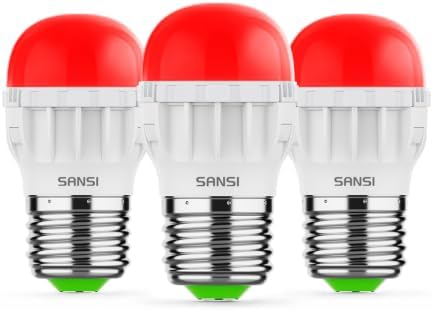
The SANSI swaps amber for deep red: a 670nm wavelength, verified by laboratory spectrum analysis per the listing, blocks 100% of blue and green light, the highest stated blocking figure here. Its 5W bulb casts 80 lumens from a compact A11 body, the dimmest stated output in this group, in a 3-pack at 0.23 pounds. The listing suggests using it 1 to 2 hours before bedtime, and morning use may help stabilize circadian rhythm through the day. The trade-off is range: 80 lumens fits a night light, not lighting a whole room, and red is the only color this listing offers.
| Spec | From the listing |
|---|---|
| Wavelength | 670nm |
| Brightness | 80 lumens |
| Power | 5W |
| Pack | 3 Pack |
| Weight | 0.23 pounds |
| Color | Red |
Buying Checklist
- Measure the nursery lamp and socket first: all five use an E26 base, but the Wivety size figures disagree (A15 against A19), so check the product page before judging fit.
- Compare stated color temperatures: 1600K on the Wivety, 1800K on the Eastiya, 1900K on the JandCase; the Neporal and SANSI carry no Kelvin figure.
- Compare stated brightness: 750 lumens on the JandCase, 500 on the Wivety, 80 on the SANSI; lumen figures are missing for the Neporal and Eastiya.
- Decide on control first: only the Wivety states a remote, dimming range and sleep timers.
- Compare 2-3 finalists side by side on the product page, and confirm the return window there before ordering.
FAQ
Which of these bulbs states the lowest color temperature?
The Wivety states 1600K, the lowest stated color temperature here, followed by the Eastiya at 1800K and the JandCase at 1900K. The Neporal states amber light and carries no Kelvin figure, and the SANSI states a 670nm red wavelength instead of a Kelvin figure, so neither joins the temperature ranking.
Which pick gives the brightest stated light?
The JandCase gives the brightest stated light at 750 lumens with a 60W-equivalent rating, followed by the Wivety at 500 lumens. The SANSI states 80 lumens, the dimmest stated output here, while the Neporal and Eastiya carry no lumen figure, so their brightness cannot be ranked against the other three.
What should I check on the Wivety before ordering?
Check the size figures first: the bulb reads A15 in the title against A19 in the size field, so confirm which size fits the lamp on the product page. Also note that the remote, the 0.1%–100% dimming range and the 6 sleep timers are stated only for the Wivety, so the other four carry no dimming figure.
Final Verdict
The JandCase 2-pack leads on stated brightness at 750 lumens and 1900K, while the Wivety earns the control pick with its remote, 0.1%–100% dimming and six sleep timers at 1600K. The Eastiya covers the middle ground at 1800K and 9W in a 2-pack, the Neporal keeps things simple at 6W with flicker-free amber light, and the SANSI answers night-only use with 670nm red at 80 lumens. Match the color temperature and the stated lumen figure to the nursery lamp, and settle the Wivety A15/A19 question on the product page first.
Prime covers fast, free delivery on eligible items. See whether a Prime free trial is available for your account.
Check Prime on Amazon →Types of Light Bulbs
Standard light bulbs (outside of the smart, vanity, motion-sensor, and solar categories) are grouped mainly by technology and by base type.
LED bulbs use the least energy and last the longest of common bulb types. Incandescent bulbs are the traditional, least efficient option, now largely phased out in many markets. CFL (compact fluorescent) bulbs sit between the two in efficiency but contain a small amount of mercury, needing careful disposal. Base types (like the common E26/E27 screw base) must match the fixture's socket for a bulb to fit and make proper contact.
A bulb's color temperature (measured in Kelvin) and its wattage-equivalent brightness are two separate specs - matching both to the fixture's intended use matters more than focusing on just one number when comparing bulbs.
Frequently Asked Questions
Why are LED bulbs more efficient than incandescent bulbs?
LEDs convert more of their energy into visible light rather than heat, which is the core reason they use less power than incandescent bulbs for similar brightness.
Do CFL bulbs need special disposal?
Yes - CFLs contain a small amount of mercury, so they should be disposed of through proper recycling rather than regular household trash.
What does a bulb's base type mean?
It refers to the screw or pin fitting (like the common E26/E27 screw base) that must match the fixture's socket for the bulb to fit and make proper contact.
Related Guides
Product and ASIN Reference
| Product | ASIN | Buy |
|---|---|---|
| JandCase Sleep Light Bulb | B0BZY7K5KX | View on Amazon |
| Neporal Amber Sleep Light Bulbs | B0H2LGJTNF | View on Amazon |
| Wivety Amber Sleep Light Bulb | B0GL27BVGQ | View on Amazon |
| Eastiya Amber Light Bulbs | B0DRTMF3HR | View on Amazon |
| SANSI Red Light Bulbs | B0H28SBKNZ | View on Amazon |


Write Your Review
No reviews yet. Be the first to share your experience!