
The BN-LINK switch is the most complete timer in this set, with 18 stated on/off programs, a blue backlight, a backup battery, DST mode and a random vacation mode in one in-wall switch. It covers the widest range of stated features, from a full week of schedules to a lived-in look while you are away, and it fits both single-pole and 3-way wiring. If your main need is a switch that handles many schedules without extra hardware, it is the one to look at first.
The other four switches each win on a narrower point. GE adjusts sunrise and sunset times through the year on its own, Ortis holds the most stated programs at 49, DEWENWILS repeats 7 programs every day at 1-minute intervals and keeps its settings for 3 months without power, and Honeywell Home keeps things simple with 7 programs a week and a manual mode. The differences that matter most are program count, sunrise and sunset control, wiring, and load limits. Honeywell Home, in particular, needs a load of at least 40 watts and does not work with CFL bulbs, so check your bulbs before you choose it.
As an Amazon Associate, we earn from qualifying purchases.


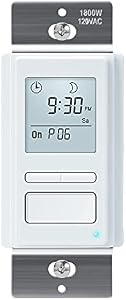

Pick by Your Need
- Best overall: BN-LINK. 18 stated programs, DST, a backup battery and a random mode in one switch.
- Best for sunrise and sunset: GE. SunSmart adjusts on and off times through the year without reprogramming.
- Best for the most programs: Ortis. 49 stated on/off programs with sunrise and sunset set by latitude and longitude.
- Best for daily repeats: DEWENWILS. 7 stated programs per day at 1-minute intervals, with settings held 3 months without power.
- Best for a simple weekly routine: Honeywell Home. 7 stated programs per week with a manual mode, for loads of 40 to 500 watts.
Quick Answer
Choose the BN-LINK switch if you want the broadest stated feature set, with 18 programs, a backup battery and a random mode. Choose GE if you want sunrise and sunset times handled for you, or Ortis if you want the most stated programs at 49. DEWENWILS suits a schedule that repeats the same times every day, while Honeywell Home suits a plain weekly routine on loads of 40 watts or more with bulbs other than CFL.
Comparison Table
| Switch | Stated programs | Sunrise / sunset | Random mode | Backup battery | Wiring |
|---|---|---|---|---|---|
| BN-LINK | 18 on/off | not stated | Yes | Yes | Single-pole or 3-way |
| Honeywell Home RPLS530A | 7 per week | not stated | not stated | not stated | Single-pole (2-wire) or 3-way |
| GE | 7 per week | SunSmart auto-adjust | Yes, up to 30 min | not stated | Single-pole or 3-way, neutral wire required |
| Ortis | 49 (7 x 7) | By latitude and longitude | Yes | not stated | not stated |
| DEWENWILS | 7 per day | not stated | Yes, ±30 min | Yes, 3 months | Single-pole, neutral wire required |
Decision Guide
Program count is the first split in this set, and the numbers are not directly comparable. Ortis states 49 on/off programs across a 7-day cycle, BN-LINK states 18, GE and Honeywell Home state 7 per week, and DEWENWILS states 7 per day. A weekly count of 7 means one on/off time can repeat every day and still count as a single program, so Honeywell Home and GE can cover a simple daily routine with room to spare. DEWENWILS, by contrast, gives you 7 fresh slots every day, which suits a schedule that changes shape from morning to evening. If your week has many different on and off times, Ortis and BN-LINK hold far more of them than the rest.
Sunrise and sunset control is the second split. GE uses SunSmart technology to adjust sunrise and sunset settings through the year for your region, so the switch follows the seasons without reprogramming. Ortis takes a different route: you enter your local latitude and longitude, and the timer works out sunrise and sunset times itself. BN-LINK, Honeywell Home and DEWENWILS state no sunrise or sunset feature, so they switch lights on fixed clock times instead. If your porch or outdoor lights should follow the dark rather than the clock, GE or Ortis is the better fit.
Wiring decides whether a switch can even go in your wall. GE states that a neutral wire is required, and DEWENWILS states the same. Honeywell Home states a single-pole 2-wire connection or a multiswitch 3-way connection, which is the most flexible wiring stated in this set. BN-LINK states single-pole and 3-way compatibility. Ortis gives no wiring detail in the facts given, so check the switch and your wall box before you buy it.
Load limits and bulb types are the last check, and they matter most with Honeywell Home. It states a 500-watt maximum and a 40-watt minimum, and it states plainly that it is not compatible with CFL bulbs. A single low-wattage LED bulb can fall below that 40-watt floor, so add up the wattage on the circuit before choosing it. GE states control of LED, CFL, incandescent and halogen bulbs, and DEWENWILS states compatibility with LED and CFL bulbs. BN-LINK and Ortis state no load range or bulb limits in the facts given.
Backup power is a smaller but real difference. BN-LINK states a backup battery, and DEWENWILS states that its backup battery keeps settings for 3 months in a power outage. GE, Honeywell Home and Ortis state no backup battery, so a long outage could mean re-entering your schedule on those three.
1. BN-LINK 7-Day Timer Switch — Best overall
The BN-LINK switch holds 18 on/off programs across a 7-day schedule, the second-highest stated count in this set, and pairs that with a blue backlight that keeps the display easy to read while you program it. Its DST mode adjusts for seasonal clock changes with one-touch control, and its backup battery keeps your schedule through a power cut. The random vacation mode varies the timing to give the look of an occupied home, and the switch fits both single-pole and 3-way setups. The trade-off is that no sunrise or sunset feature is stated, so its times stay fixed to the clock while GE and Ortis follow the seasons.
| Spec | From the listing |
|---|---|
| Programs | 18 on/off programs, 7-day scheduling |
| Modes | DST mode, random vacation mode |
| Wiring | Single-pole or 3-way |
| Backup battery | Yes |
| Dimensions | 4.92 x 3.23 x 2.44 in |
| Weight | 0.0 lb as listed — a placeholder figure, not a usable weight |
2. Honeywell Home RPLS530A — Best for a simple weekly routine

The Honeywell Home RPLS530A holds up to 7 programs per week, with each program able to run on a single day or repeat every day, and it offers two operating modes: manual, which works like a conventional on/off switch, and automatic. It mounts flush with a standard decorative wall plate, which is not included, and it is also available in Almond. The load range is stated plainly at 500 watts maximum and 40 watts minimum, and the switch is not compatible with CFL bulbs. The trade-off is clear: it holds the joint-fewest stated programs in this set and carries the strictest load limits, so it suits a plain routine on the right bulbs and not much else. Skip it if your circuit carries CFL bulbs or a total load under 40 watts.
| Spec | From the listing |
|---|---|
| Programs | Up to 7 programs (7 on/off times) per week |
| Modes | Manual (conventional on/off) and automatic |
| Load range | 500 W maximum / 40 W minimum |
| CFL bulbs | Not compatible |
| Wiring | Single-pole (2-wire) or multiswitch (3-way) |
| Dimensions / weight | 1.69 x 1.5 x 4.06 in; 0.25 lb |
3. GE 7-Day SunSmart Timer Switch — Best for sunrise and sunset

The GE switch uses SunSmart technology to adjust sunrise and sunset settings through the year for your region, so outdoor and porch lights follow the changing daylight instead of fixed clock times. It holds up to 7 on/off programs through the week, and its random security feature shifts settings by up to 30 minutes to give a lived-in appearance. It replaces single-pole or 3-way switches that have a neutral wire, and it controls LED, CFL, incandescent and halogen bulbs plus other permanently installed fixtures. An optional daylight saving time setting handles clock changes without reprogramming. The trade-off is program count: 7 per week is the joint-lowest stated count here, so a week with many different times will run out of slots.
| Spec | From the listing |
|---|---|
| Programs | Up to 7 on/off programs per week |
| Sunrise / sunset | SunSmart auto-adjust through the year |
| Random mode | Shifts settings by up to 30 minutes |
| Wiring | Single-pole or 3-way, neutral wire required |
| Bulb types | LED, CFL, incandescent, halogen |
| Dimensions / weight | 6.8 x 4.75 x 2.3 in; weight not stated in the listing |
4. Ortis 7-Day Timer Switch — Best for the most programs
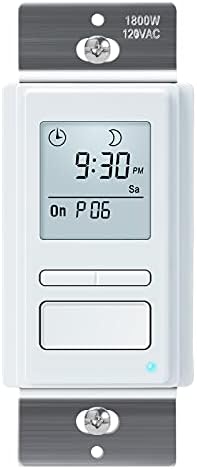
The Ortis switch states up to 7 x 7, or 49, on/off programs that can repeat on a 24-hour or 7-day cycle, the highest stated program count in this set by a wide margin. Its sunrise and sunset control works from your local latitude and longitude, so the timer works out dawn and dusk itself and switches lights on and off to match, which the listing ties to lower energy use. A built-in random mode varies the schedule to make the home look occupied while you are away. The switch sits flush with standard decorator wall plates, and its backlit LCD display stays visible at night and in low light. The trade-off is what is missing: no backup battery and no DST mode are stated, so a power cut or a clock change may mean setting it up again.
| Spec | From the listing |
|---|---|
| Programs | Up to 7 x 7 = 49 on/off programs |
| Cycle | Repeats on a 24-hour or 7-day cycle |
| Sunrise / sunset | Automatic from latitude and longitude |
| Random mode | Yes, varies the schedule |
| Display | Backlit LCD |
| Dimensions / weight | 1.65 x 1.69 x 4.13 in (switch body only); weight not stated in the listing |
5. DEWENWILS 7-Day Timer Switch — Best for daily repeats

The DEWENWILS switch holds up to 7 on/off programs in a day, with a 1-minute interval between settings, and every program repeats weekly, which makes it the most precise daily timer stated in this set. Its backup battery keeps settings for 3 months in a power outage, and its random mode turns lights on or off within 30 minutes either side of the chosen time to give the look of an occupied home. A DST mode handles seasonal clock changes, and a neutral wire is required, with all accessories included and wire caps to make wiring easier. The switch is compatible with LED and CFL bulbs, and you press the door to turn it on or off by hand. The trade-off is wiring scope: it is described as a single-pole switch, and no three-way use is stated, so it does not cover a light controlled from two places. Skip it if your light is switched from two locations.
| Spec | From the listing |
|---|---|
| Programs | Up to 7 on/off programs per day, 1-minute interval |
| Backup battery | Keeps settings for 3 months |
| Random mode | Within ±30 minutes of the chosen time |
| Wiring | Single-pole, neutral wire required |
| Bulb types | LED and CFL |
| Dimensions / weight | 5.63 x 3.27 x 2.17 in; 0.35 lb |
Buying Checklist
- Count how many on/off times your week actually needs, and remember that 7 per week covers one daily routine while 49 covers many.
- Check whether your wall box has a neutral wire, since GE and DEWENWILS state that one is required.
- Add up the wattage on the circuit, and remember that Honeywell Home needs at least 40 watts and does not work with CFL bulbs.
- Decide whether you want sunrise and sunset control, which only GE and Ortis state.
- Check whether the switch keeps its settings through a power cut: BN-LINK and DEWENWILS state a backup battery, and DEWENWILS states 3 months.
- Check the wall plate fit: Honeywell Home mounts flush with a standard decorative wall plate that is not included, and Ortis sits flush with standard decorator wall plates.
FAQ
Do all five switches need a neutral wire?
No. GE and DEWENWILS state that a neutral wire is required. Honeywell Home states a single-pole 2-wire connection or a multiswitch 3-way connection, and BN-LINK states single-pole and 3-way compatibility, with no neutral wire mentioned for either. Ortis gives no wiring detail in the facts given, so check your wall box before choosing it.
Can I use the Honeywell Home switch with CFL bulbs?
No. The Honeywell Home RPLS530A states plainly that it is not compatible with CFL bulbs, and it also states a 40-watt minimum load alongside a 500-watt maximum. If your circuit carries CFL bulbs, or a total load under 40 watts, choose one of the other four switches instead. GE states control of LED, CFL, incandescent and halogen bulbs, and DEWENWILS states compatibility with LED and CFL bulbs.
Which switch holds the most programs?
Ortis, with up to 49 stated on/off programs across a 7-day cycle. BN-LINK is next at 18 stated programs. DEWENWILS holds 7 stated programs per day, which adds up across a week but resets its slots daily, while GE and Honeywell Home hold 7 stated programs per week.
Final Verdict
The BN-LINK switch takes the top spot because it pairs 18 stated programs with a blue backlight, a backup battery, DST mode and a random mode, the broadest stated feature set in this set. GE is the pick if sunrise and sunset matter most, since SunSmart adjusts those times through the year without reprogramming. Ortis is the pick if program count matters most, with 49 stated slots against 18 for the next-best switch. DEWENWILS is the pick for a daily routine that repeats at precise times, with 7 programs a day at 1-minute intervals and settings held for 3 months without power. Honeywell Home is the pick for a plain weekly routine, as long as your load stays between 40 and 500 watts and your bulbs are not CFL.
Prime covers fast, free delivery on eligible items. See whether a Prime free trial is available for your account.
Check Prime on Amazon →




Write Your Review
No reviews yet. Be the first to share your experience!